Paragentism
The personal philosophy underlying Paragent
Paragentism is a personal operating system concerned with agency under constraint. It asks a single, persistent question: what actions increase my future ability to act? Everything else is secondary.
At its core, Paragentism rejects the idea that the world is, or can be made, fair in any robust sense. Fairness is a local convenience, not a global property. In low-stakes environments, fairness norms reduce friction and simplify coordination. In high-stakes reality—where incentives are strong, information is asymmetric, and outcomes matter—fairness collapses into theatre. Attempts to enforce it reliably make systems worse.
Paragentism therefore does not orient around moral claims. It orients around structural truths: incentives dominate intention; systems select behaviour; scale amplifies design errors. From this view, most personal frustration is not caused by hostile actors, but by being embedded in systems that punish agency while claiming to value it.
The philosophy treats freedom not as an abstract right, but as future optionality. Agency is the capacity to make meaningful choices later, not the indulgence of impulse now. Many behaviours that feel virtuous in the short term—compliance, deference, self-sacrifice—are anti-agentic over time because they narrow future moves.
Paragentism also rejects martyrdom. Sacrificing yourself for a system that cannot reciprocate is not noble; it is a category error. Systems do not feel gratitude. They only respond to incentives. When continued participation reduces agency without producing offsetting leverage, exit becomes rational.
This philosophy is not optimistic, pessimistic, or cynical. It is instrumental. It does not ask how people should behave, but how behaviour is actually shaped. From this perspective, the most ethical move is often the most agentic one—because it preserves the capacity to act competently in the future.
Paragent extends this philosophy from the individual to the organisational level. Where Paragentism is about staying free enough to live well, Paragent is about designing systems where many people can remain agentic at once.
The Paragent 2×2: Agency Interactions
Paragentism evaluates action not only by its effect on your agency, but by how it interacts with the agency of others. Many failures occur because people optimise one axis while ignoring the other.
The framework is a 2×2:
- Vertical axis: Your agency (enhanced ↔ eroded)
- Horizontal axis: Other people's agency (enhanced ↔ eroded)
This produces four structurally distinct outcomes.
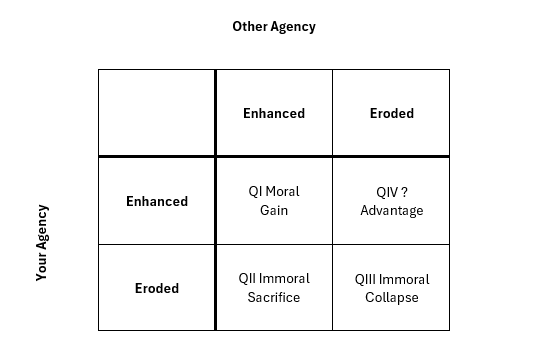
Most people believe they are operating in QI. In reality, systems push them toward QII while rewarding others in QIV. Collapse (QIII) follows.
Paragentism is the practice of:
- Avoiding QII and QIII
- Preserving access to QI where incentives genuinely align
- Understanding QIV without self-deception
This is not a moral philosophy. It is an agency-preservation framework for real systems.
QI — Moral Gain
Your agency enhanced. Other agency enhanced.
These are positive-sum actions. You increase your own future optionality while also enabling others to remain capable actors. This is the narrow domain where cooperation, trust, and "doing good" actually work—typically in low-scale, aligned-incentive environments.
Paragentism does not reject this quadrant. It simply observes that it is rarer than advertised and fragile under scale.
QII — Immoral Sacrifice
Your agency eroded. Other agency enhanced.
This is the martyrdom quadrant. You lose future capacity so that others may gain or maintain theirs. The system may praise this behaviour morally, but structurally it is unstable: you become dependent, resentful, or replaceable.
Paragentism treats persistent residence here as a category error. Systems do not repay sacrifice; they absorb it.
QIII — Immoral Collapse
Your agency eroded. Other agency eroded.
This is pure loss. No one becomes more capable. Value is destroyed. These outcomes are often justified after the fact with moral language ("necessary", "for the greater good"), but structurally they indicate failed design or perverse incentives.
Paragentism treats this quadrant as the primary danger zone to be exited as early as possible.
QIV — Advantage
Your agency enhanced. Other agency eroded.
This is asymmetric gain. You increase your future optionality at the expense of others' capacity to act. Many high-stakes systems—markets, bureaucracies, politics—select for behaviour in this quadrant, even while condemning it rhetorically.
Paragentism does not moralise this quadrant. It treats it as a structural reality that must be recognised, navigated, and constrained deliberately. Refusing to see it does not prevent it; it only guarantees you occupy QII or QIII instead.