Dodos Are Not Extinct
The call that should not have taken a week
Recently I spent hours across nearly a week trying to get Dodo to fix a two-factor authentication failure on my own account. The problem was simple. The resolution was technically trivial. What stood between me and a working phone plan was not complexity — it was a support structure that seemed to have been precision-engineered to prevent resolution. This is a class of problem I have written about before, but this time there is a more useful ending.
Each call produced a different operator, no case history, no continuity, and a set of permissions so narrow that the person on the other end of the line was structurally incapable of helping me regardless of whether they wanted to. They were not unhelpful people. They were people who had been converted into unhelpfulness by design. Their agency had been stripped not because any individual decided to obstruct me, but because somewhere above them a decision had been made that discretion was more dangerous than helplessness. The cost of the occasional bad individual decision had been replaced with the guaranteed cost of universal incapacity.
I eventually resolved it by doing what any competent adult can do once they understand the system: I made the cost of not resolving it visible and specific. I documented everything. I referenced the Telecommunications Industry Ombudsman. I made it clear that the next interaction would be a formal complaint with a paper trail. The problem was solved within twenty-four hours.
I had not found a human with agency. I had found a pressure point the system was actually afraid of and applied it precisely. I had, in a small and inconsequential way, infected the system like a virus and co-opted some of its cells for my purpose.
What I had encountered was not a bad company. It was a company in a particular stage of a predictable lifecycle — one that every organisation eventually reaches if it survives long enough and grows past a critical threshold.
The Dodo I called is not a failed organisation. It is a successful one. That is exactly the problem.
The split that explains everything
Every organisation articulates a purpose. Dodo exists to provide telecommunications services to its customers. The support structure nominally exists to solve customer problems. These are the stated purposes and they are not lies exactly — they are something more interesting than lies. They are the legitimising narrative.
The actual operating principle of any organisation past a certain scale is self-preservation. Not survival in the narrow sense of staying solvent, but something broader — the perpetuation of the organisation as it currently exists, with its current structures, its current hierarchies, its current ways of doing things. Purpose gets invoked selectively to justify what the self-preservation logic has already decided. When purpose and survival align, the organisation looks principled. When they diverge, survival wins and purpose is narrated around it.
This is not cynicism. It is structure. The gap between stated purpose and operating logic is not a betrayal committed by bad actors. It is what organisations become when they scale past the point where shared values alone can govern behaviour. Past a certain size — Robin Dunbar's research suggests around 150 people — you cannot maintain alignment through a single charismatic leader who holds the whole thing together through personal authority and relationship. Dunbar's original research drew on historical contexts where that leader was almost always male, but the dynamic applies regardless of who occupies the role. What changes past the threshold is not the gender of the leader but the nature of the problem: one person, however compelling, cannot personally know and therefore personally influence everyone in an organisation that has grown beyond that scale. You need imposed constraint that is deployed through a delegation of authority. And delegated constraint, once introduced, has its own growth logic entirely independent of the need that created it.
The support worker who could not help me was not failing at her job. She was succeeding at it perfectly. Her job had been redefined, without anyone saying so explicitly, from solving customer problems to closing tickets within policy. The policy existed not to serve customers but to protect the organisation from the cost of discretion. She was doing exactly what the system required. The system had simply stopped requiring what it claimed to require.
This is the split. Vision — what the organisation claims it exists to do — and the Organisational Imperative — the drive toward growth and self-perpetuation that starts as survival and becomes self-justifying at scale. In the early life of any organisation these two forces are nearly identical. The founder grows the business because growth serves the mission. Over time they decouple. Growth stops being in service of Vision and becomes the thing Vision has to justify itself against.
When that inversion completes, the stated purpose becomes what it was at Dodo: moral theatre.
A predictable lifecycle
Les McKeown spent fifteen years launching and advising organisations before identifying something most founders discover too late: the trajectory is not random. Every organisation moves through the same sequence of stages, driven by the same forces, producing the same crises at the same thresholds. He called the framework Predictable Success.
The stages run from Early Struggle through Fun, Whitewater, Predictable Success, Treadmill, Big Rut, and Death Rattle. Each stage has a characteristic balance of three forces: Vision, which is what the organisation claims it exists to do; Growth, which is the operational imperative that starts as survival and becomes self-justifying; and what I will call Fuckwittery — the accumulation of process, constraint, compliance, and procedure that exists not to serve the mission but to serve itself. McKeown is less harsh than I am and calls these things systems and processes. This label glosses over that they are constraints and therefore Fuckwittery in a Paragentist frame.
These three forces share the organisation's finite capacity. This is not zero-sum in the strict technical sense — the total amount of human activity does not shrink. What we are describing is how the organisation splits its attention, effort, focus, and budget across three competing orientations. Every shift toward Fuckwittery is a shift away from Vision and Growth. The composition changes across the lifecycle in a direction that is, once you see it, almost impossible to unsee.
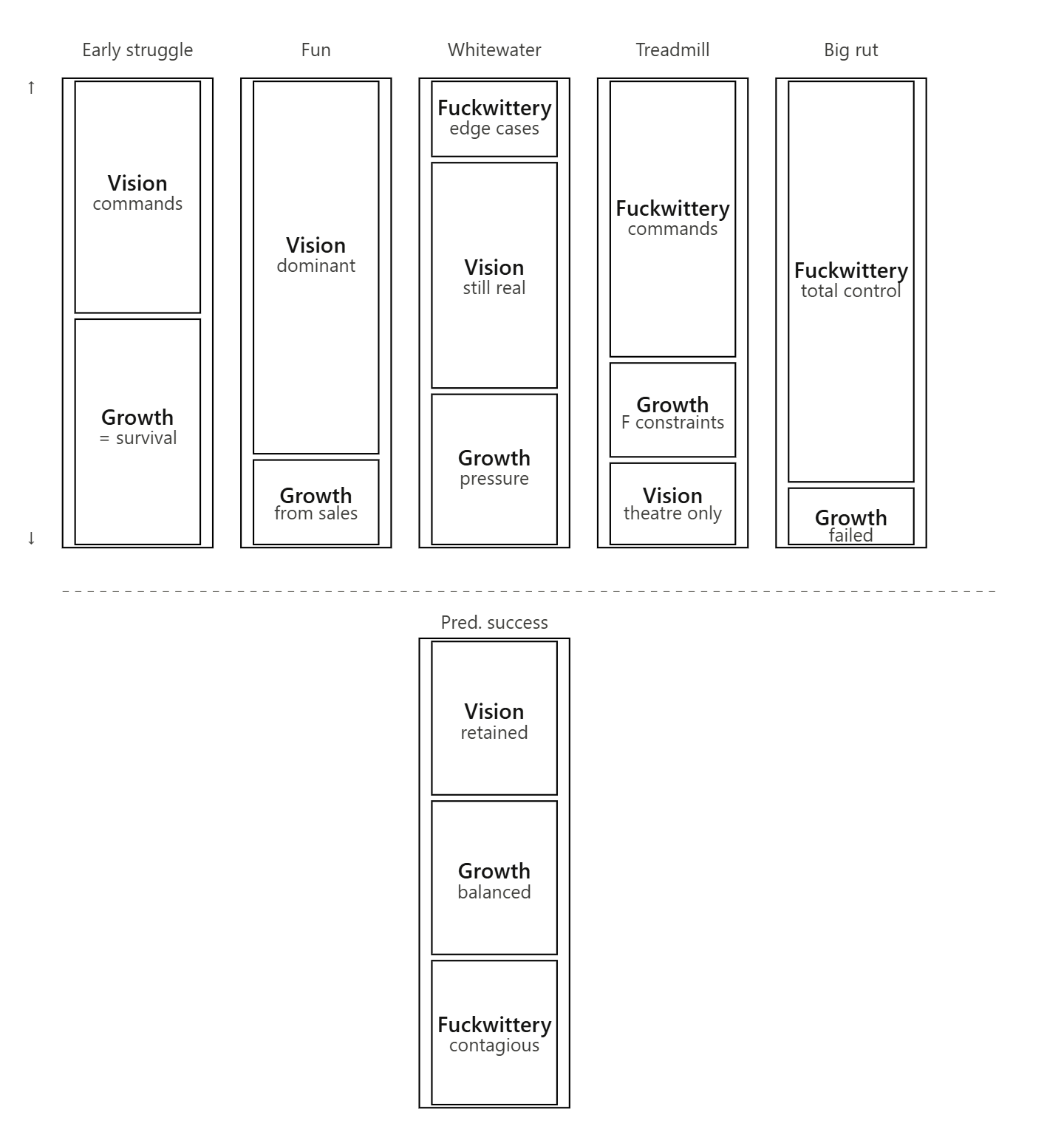
In Early Struggle, Vision and Growth are equal partners with Vision commanding. Growth is survival — you grow because the mission requires resources to exist. Vision constrains what kinds of growth are acceptable. There is no Fuckwittery because the org is too small and too hungry to generate it.
In Fun, Vision dominates. Growth is largely self-funding through sales velocity — the market is responding, the mission is working, and the energy of early success masks how fragile the foundations are. The moral ceiling is largely intact. Small compromises begin at the edges as sales success becomes addictive in its own right, but they are not yet visible as compromises.
Whitewater arrives when success becomes complexity. The organisation has grown past its maximum efficient moral scale — the point at which Vision alignment can no longer be maintained through a single leader's personal reach. For the first time, imposed constraint deployed through delegated authority becomes structurally necessary. This is where Fuckwittery makes its entry.
It is important to be precise about what this first Fuckwittery is. It is not good governance. It is a tolerable maladaptation — the organisational equivalent of losing weight while suffering a serious illness. The outcome feels welcome. The mechanism is bad. What is almost universally missed is that the illness introducing this particular symptom may be cancer. Other controls are available: hire more carefully for values alignment, lead with more explicit purpose, invest in culture that makes constraint unnecessary. These are harder. Fuckwittery is easier. Most organisations take the easy path without understanding what they are actually introducing into the system.
Predictable Success is the stage McKeown names as the goal. All three forces are present in roughly equal measure, with Vision commanding, Growth balanced, and Fuckwittery present but subordinate. It is a genuinely good place to operate from. It is also profoundly unstable, for reasons the framework makes clear only when you look at who is doing the work at each stage.
Treadmill is where most large organisations you recognise actually live. Fuckwittery commands. Growth operates within Fuckwittery's rules. Vision is present only as theatre — invoked in annual reports, mission statements, and all-hands addresses, but not operative in the decisions that actually shape the organisation's behaviour. The cancer has spread. It is not too late to save the company, but major surgery and a sustained course of treatment will be required. Most organisations at this stage choose neither, because the people who would need to authorise the surgery are the same people the surgery would remove. The Dodo support structure is a Treadmill structure. The stated purpose of serving customers is the theatrical layer. The operative logic is self-preservation through process.
Big Rut is Treadmill with the self-diagnostic capacity removed. The organisation can no longer identify its own condition. The cancer is now terminal. The org will move toward one of two endpoints: Death Rattle, where the market eventually does its job and the organisation ceases to exist, or Too Big to Fail, where the outside world reorganises around the organisation to keep it viable even though it does not deserve to be. In the Too Big to Fail state, Fuckwittery does not decrease. The subsidy is external and structural and indefinite. The patient is kept on life support not because recovery is expected but because the cost of withdrawal is judged to be higher than the cost of continuation.
It is worth noting that non-market organisations — public services, government agencies, large bureaucracies — arrive at Big Rut far more easily than commercial ones, because the market correction mechanism never applies. There is no revenue test, no viability signal, no Death Rattle pressure. Fuckwittery compounds without any external circuit breaker. Too Big to Fail is not one of two possible endpoints for these organisations. It is effectively the default.
Who drives each stage
McKeown identifies four personality types whose relative presence and authority determines which stage an organisation inhabits: the Visionary, the Operator, the Processor, and the Synergist.
The Visionary is the source of genuine intrinsic motivation. They are attached not to the product or the revenue line but to what the organisation could and should really be. This is why founders can pivot repeatedly without losing conviction — they are not attached to the current expression of the mission, only to the mission itself. The V is also what makes the early employment proposition make any sense at all. Nobody joins a startup for the salary or the security. They join because a Visionary made the mission feel real and worth the bet.
The Operator is ends-focused. They want the problem solved, the customer served, the thing shipped. They have little patience for process that does not directly produce outcomes and will work around it when they can. The O is the execution engine of early-stage organisations and the source of the heroic firefighting that characterises Whitewater — solving problems personally, repeatedly, at cost.
The Processor is means-focused. The system, the process, the procedure is the product for them. This is not, on its own, pathological. Organisations in or past Whitewater need people who can build systems that work without requiring personal intervention. The P's contribution at the right scale is real. The problem is what happens when the P cohort is not contained.
Because unlike Visionaries and Operators, Processors scale. The V function is irreducibly scarce — you cannot hire more vision, you cannot automate insight, you cannot distribute genuine intrinsic motivation across an org chart. The O function is bounded by personal intensity — strong Operators burn bright and burn out, and they do not naturally replicate their own kind. The P function is the opposite of both. It is infinitely scalable, highly automatable, and entirely comfortable in institutional environments. Processors hire Processors. They build systems that require Processors to operate. They are promoted by the same institutional machinery they helped construct because that machinery selects for the competencies they possess. They are, in the most precise possible sense, contagious.
If you have worked in a large organisation and felt the accumulated weight of process, approval chains, compliance requirements, reporting obligations, and policy constraints pressing down on your ability to simply do the thing you were hired to do — you have felt what Processor capture feels like from inside. It is not designed to frustrate you. It is not malicious. It does not need to be. It is simply the natural output of a cohort that is purpose-agnostic by disposition, that experiences the imposition of constraint as the exercise of competence, and that will expand its territory indefinitely unless something stops it.
The moral theatre completes the picture. Processors in authority do not say: I am building these constraints because systematising is how I experience power. They say: this process exists to protect quality, manage risk, ensure fairness, serve the customer. The legitimising narrative is borrowed from Vision and applied to what is, underneath, a dominance move. The gap between the stated reason and the operative reason is the same gap we identified at the organisational level. It can be just as invisible to the person deploying it.
If you are reading this and recognising yourself — if you are the person who adds the approval step, writes the policy, mandates the reporting format, requires the sign-off, if your job in some meaningful sense is to compel compliance of some kind — I am not accusing you of bad faith. I am asking you to stop being such a Fuckwit. The question worth sitting with is not whether your process serves a purpose, but whether it serves the organisation's Vision or your own comfort with control. Those feel identical from the inside. They produce very different organisations.
The Synergist and the only control that matters
McKeown's solution to the instability of Predictable Success is the Synergist — a role that holds Visionaries, Operators, and Processors in productive tension by translating between them and keeping each oriented toward collective purpose rather than dispositional preference.
In my view the framing is too diplomatic. The reality is more specific.
Visionaries and Operators do not need to be held in check. The V burns out, gets marginalised by headcount, and eventually exits or becomes a figurehead. The V is naturally self-limiting at scale. The O solves problems until the problems outpace them, then either develops systemic thinking or gets bypassed. The O is also naturally self-limiting. Neither type colonises. Neither promotes its own kind as an institutional survival strategy. Neither requires external containment.
The Processor is categorically different. The Synergist is not a general harmony role in my view. It is specifically, precisely, and only a Processor-containment role. Everything else McKeown says about it is true but secondary. The primary function is keeping the Borg in their section and out of the bridge.
The Borg analogy is not rhetorical. The Processors do not hate the organisation's mission. They are not consciously undermining it. They are simply optimising for assimilation because that is what their disposition produces at scale, and they will not stop unless stopped, and they get stronger as they grow.
There are only a small number of structural responses available. McKeown himself acknowledges that deliberately returning to Fun — staying small, staying below the Dunbar threshold, refusing the scale that makes Processors necessary — is a legitimate choice, not a failure. For organisations that have already scaled, the Synergist is the primary brake. Other mechanisms exist and deserve their own treatment. What matters here is the principle: Fuckwittery requires active, structural, ongoing containment. It does not self-limit. Hoping it will is how you end up on the phone to Dodo for a week.
The endpoints
The lifecycle produces four stable destinations.
Fun is honest and underrated. Small enough to stay below maximum efficient moral scale, Vision intact, no Fuckwittery required. McKeown treats it as a lesser outcome than Predictable Success. I am not sure he is right.
Predictable Success is real but fragile. It requires a functioning Synergist and an organisational culture that keeps the Processor cohort subordinate to Vision. Most organisations touch it briefly on the way to somewhere else.
Death Rattle is what happens when the market finally does its job. The organisation dies of its own accumulated Fuckwittery. The market correction arrives too late to undo the damage done, but it arrives. There is a grim integrity to it.
Too Big to Fail is the final indignity. The organisation has completely consumed its own Vision, cannot self-diagnose, cannot reform, and persists not because it deserves to but because the cost of its failure has been successfully externalised onto everyone else. Regulators, governments, captive customers, and taxpayers become the life support system. The Fuckwittery does not decrease. The world reorganises around it.
The actual dodo
The dodo went extinct not simply because it was naive. It evolved on Mauritius in the complete absence of predators and therefore had no reason to develop fear responses or flight capability. When humans arrived in the late seventeenth century they found an animal that would walk toward them. It was not stupidity. It was the entirely rational product of an environment that had never required otherwise.
What followed was not farming. It was opportunistic slaughter, compounded by the cats, dogs, rats, and pigs that arrived with the sailors and systematically destroyed the dodo's eggs and ground nests. The dodo was not hunted to extinction by a single cause. It was destroyed by the combination of direct predation and the collapse of the conditions that had made its existence viable.
The organisations I am describing are not the dodo. They are not naive creatures destroyed by a world they were unprepared for. They are more like the sailors — opportunistic, expansionary, and largely indifferent to what they displace. The customers, the staff who still believe in the mission, the communities that depend on the service: these are the eggs on the ground.
The dodo is not extinct. It just changed jobs.